Edexcel A level Mathematics
You can do the maths and still not get the mark.
Beat the Traps is revision built around the mistakes examiners report year after year. The domain nobody stated. The root nobody rejected. The answer left in degrees when the question was in radians.
For students who already have access. A one-time code is sent to your email address.
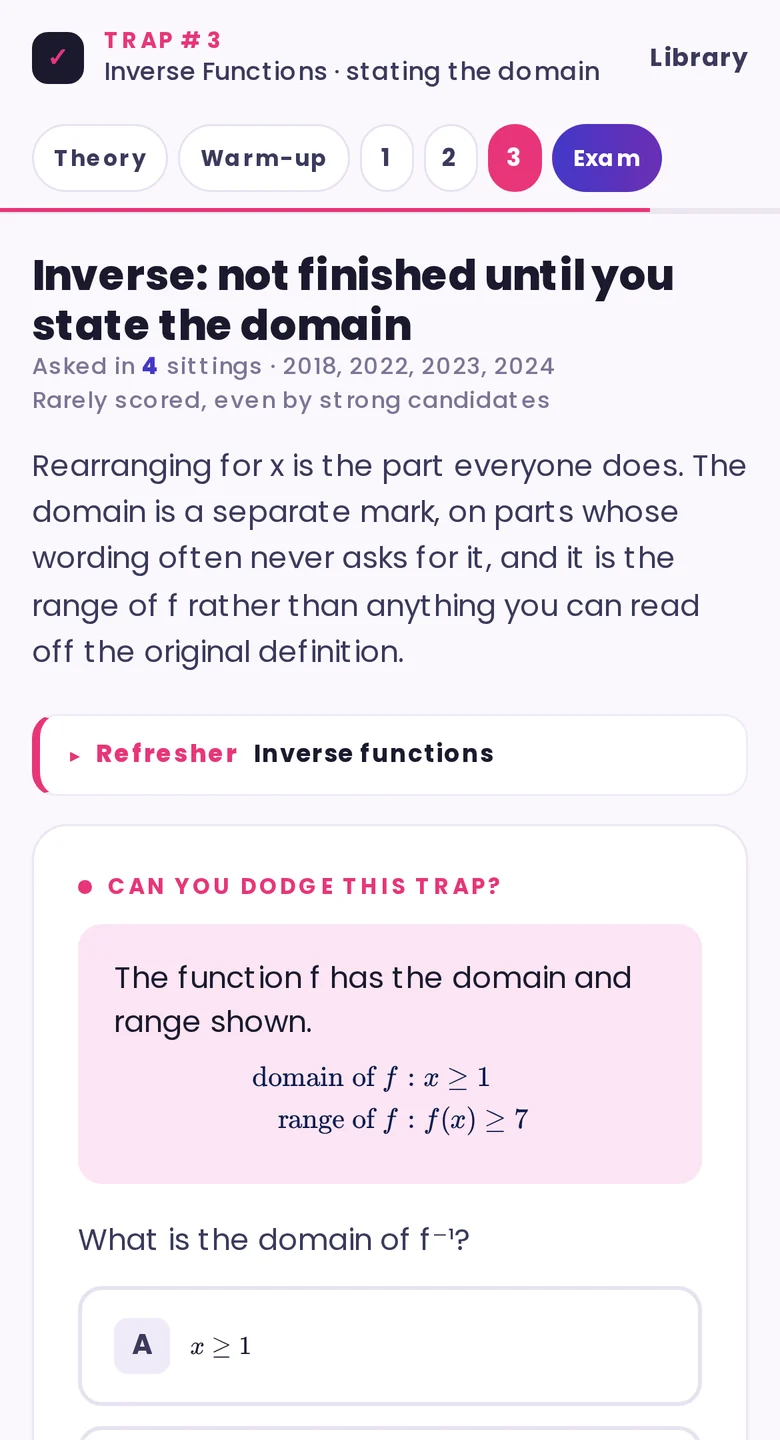
Examiner note — Inverse Functions
The domain is a separate mark on parts whose wording never asks for it. Reports across four sittings say candidates rearrange, write the inverse and stop. One calls it a point made in many previous reports.
From the examiner note in P10, Functions. Edexcel 9MA0/02 Q1 (June 2018) · 9MA0/01 Q7 (June 2023) · 9MA0/01 Q8 (June 2024) — examiner reports and mark schemes, summarised.
What a trap is
A named mistake, not a topic.
Revision usually sorts itself by topic, which is how you end up practising what you can already do. A trap is sorted the other way round: by where the marks are actually lost.
Each one gets its own section — what it looks like in a real question, why it is tempting, what the examiners said about it, and the fix that keeps the mark. Then you practise it until it stops catching you.
Personalised feedback
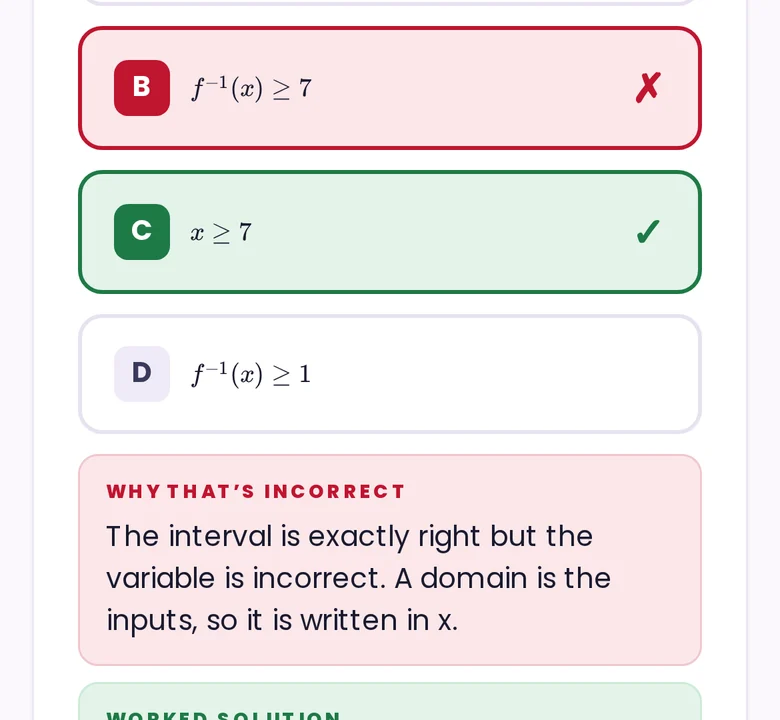
Every wrong answer gets its own explanation.
Not “incorrect, try again”. Each option is told apart from every other one, so a near miss is explained as a near miss — what was right about it, and the one thing that cost the mark.
What is inside
The library
How a module runs
Where the traps come from
Nothing here is a hunch about what students find hard.
A trap only earns a place once the same mistake has been found in all three sources for the same skill.
The papers used are Edexcel 9MA0 and 8MA0, June 2018 to June 2025.
Who made this
Built by one teacher, not a content team.
I have taught A level Maths since 2009 and have been Head of A level Maths at three schools, one of them named State Secondary School of the Decade for the South East.
Beat the Traps came out of marking the same mistakes year after year, then going back through every Edexcel paper, mark scheme and examiner report from 2018 to 2025 to find out whether they were only my students’ mistakes or everybody’s. The 139 traps are the ones that were everybody’s.
Getting access
Being tested with a small group first.
Access is by invitation at the moment. Opening to everyone later this year.
To report something that is not working, or to raise anything about your information, write to hello@sakatismaths.co.uk.
Your progress is saved on your own phone, in your browser. It is not sent anywhere. There is no advertising and no tracking of any kind.